Slices
Prepare
Have you ever had a sabbatical? If yes, what difference did it make to your spiritual life? If no, what does the idea of Sabbath rest mean to you?
Bible passage
The Sabbath Year
25 The Lord said to Moses at Mount Sinai, 2 ‘Speak to the Israelites and say to them: “When you enter the land I am going to give you, the land itself must observe a sabbath to the Lord. 3 For six years sow your fields, and for six years prune your vineyards and gather their crops. 4 But in the seventh year the land is to have a year of sabbath rest, a sabbath to the Lord. Do not sow your fields or prune your vineyards. 5 Do not reap what grows of itself or harvest the grapes of your untended vines. The land is to have a year of rest. 6 Whatever the land yields during the sabbath year will be food for you – for yourself, your male and female servants, and the hired worker and temporary resident who live among you, 7 as well as for your livestock and the wild animals in your land. Whatever the land produces may be eaten.
The Year of Jubilee
8 ‘“Count seven sabbath years – seven times seven years – so that the seven sabbath years amount to a period of forty-nine years. 9 Then sound the trumpet everywhere on the tenth day of the seventh month; on the Day of Atonement sound the trumpet throughout your land. 10 Consecrate the fiftieth year and proclaim liberty throughout the land to all its inhabitants. It shall be a jubilee for you; each of you is to return to your family property and to your own clan. 11 The fiftieth year shall be a jubilee for you; do not sow and do not reap what grows of itself or harvest the untended vines. 12 For it is a jubilee and is to be holy for you; eat only what is taken directly from the fields.
13 ‘“In this Year of Jubilee everyone is to return to their own property.
14 ‘“If you sell land to any of your own people or buy land from them, do not take advantage of each other. 15 You are to buy from your own people on the basis of the number of years since the Jubilee. And they are to sell to you on the basis of the number of years left for harvesting crops. 16 When the years are many, you are to increase the price, and when the years are few, you are to decrease the price, because what is really being sold to you is the number of crops. 17 Do not take advantage of each other, but fear your God. I am the Lord your God.
18 ‘“Follow my decrees and be careful to obey my laws, and you will live safely in the land. 19 Then the land will yield its fruit, and you will eat your fill and live there in safety. 20 You may ask, ‘What will we eat in the seventh year if we do not plant or harvest our crops?’ 21 I will send you such a blessing in the sixth year that the land will yield enough for three years. 22 While you plant during the eighth year, you will eat from the old crop and will continue to eat from it until the harvest of the ninth year comes in.

Explore
The practice of land lying fallow is not followed much nowadays. Due to advance in science, crop rotation and cover crops to replenish the soil are preferred. But in Old Testament times, it meant that the necessary nutrients that supported healthy crops could return to the soil in the Sabbath fallow year. Even food that grew naturally must be left; the apparent anomaly between verse 5 and verse 7 means that what did grow was for everyone – it wasn’t the property of the landowners, as if they’d planted it.
The Jubilee year, the year after the seventh Sabbath year, meant two years of no farming. Land had to be sold on the basis of the length of profitable time (vs 14–17). Further into the chapter, any mortgaged land returned to its original owner, and anyone who had sold themselves into slavery was released. This ideally prevented anyone from becoming too wealthy or too poor.
God promised (vs 18–22) that the abundance of harvest in the sixth year would be more than enough to provide generously for his people through and after the fallow year(s). All of this reminded them that the land belonged to God and so they must care for it, and, more than this, that their very lives depended on God.
Respond
What might it look like for a church as a whole to have a sabbatical? How could the rest for the land (and rest from labour) be expressed in terms of church life?
Bible in a year
Read the Bible in a year: Judges 15,16; Mark 5
Pray for Scripture Union
Please pray for Helen Vinter as she leads this year’s Unlimited holiday and launches Breakthrough holiday for older children and young adults with additional needs. Ask God to bless her with lots of energy and with more volunteers to help! (Today's prayer relate to this article.)
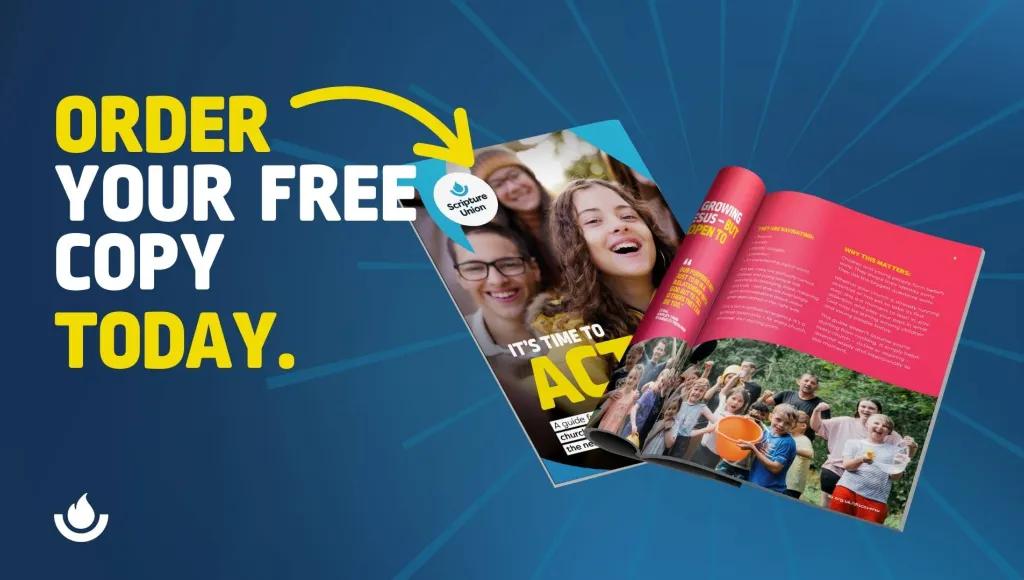
Equipping the church to reach the next generation
Across England and Wales, increasing numbers of children and young people are asking big questions about life, faith and meaning. Many are more open than we might assume – curious, thoughtful, and ready for conversations about Jesus, even when church isn’t part of their everyday world. For churches who have a heart for the next generation, this presents a real and hopeful opportunity.
Many leaders carry a deep desire to help the next generation encounter Jesus, but with full diaries and many responsibilities, knowing how to respond – or where to begin – can feel uncertain. That’s why we’ve created the It’s Time to Act guide.
It’s a simple, encouraging resource designed to help churches take thoughtful, realistic steps towards revealing Jesus to the next generation. Rather than offering big programmes or quick fixes, the guide focuses on what’s possible now – small, achievable actions that can grow over time. Inside, you’ll find practical ideas shaped by real church life that work alongside busy schedules and varied contexts. So, whether your church is just beginning to explore this opportunity, or already taking steps, the guide aims to meet you where you are and help you discern what comes next.
Our hope is that It’s Time to Act feels less like another initiative, and more like an invitation – to notice where God is already at work, and to take a next step, one step at a time.
If you’d like to explore the guide and see whether it could support your church, you can order a copy here.