Slices
Prepare
When was the last time you made a mistake? Major or minor? What were the consequences? How were things rectified?
Bible passage
The sin offering
4 The Lord said to Moses,
Leviticus 4:2
2 ‘Say to the Israelites: “When anyone sins unintentionally and does what is forbidden in any of the Lord’s commands –
Leviticus 4:22-35
New International Version - UK
22 ‘“When a leader sins unintentionally and does what is forbidden in any of the commands of the Lord his God, when he realises his guilt 23 and the sin he has committed becomes known, he must bring as his offering a male goat without defect. 24 He is to lay his hand on the goat’s head and slaughter it at the place where the burnt offering is slaughtered before the Lord. It is a sin offering. 25 Then the priest shall take some of the blood of the sin offering with his finger and put it on the horns of the altar of burnt offering and pour out the rest of the blood at the base of the altar. 26 He shall burn all the fat on the altar as he burned the fat of the fellowship offering. In this way the priest will make atonement for the leader’s sin, and he will be forgiven.
27 ‘“If any member of the community sins unintentionally and does what is forbidden in any of the Lord’s commands, when they realise their guilt 28 and the sin they have committed becomes known, they must bring as their offering for the sin they committed a female goat without defect. 29 They are to lay their hand on the head of the sin offering and slaughter it at the place of the burnt offering. 30 Then the priest is to take some of the blood with his finger and put it on the horns of the altar of burnt offering and pour out the rest of the blood at the base of the altar. 31 They shall remove all the fat, just as the fat is removed from the fellowship offering, and the priest shall burn it on the altar as an aroma pleasing to the Lord. In this way the priest will make atonement for them, and they will be forgiven.
32 ‘“If someone brings a lamb as their sin offering, they are to bring a female without defect. 33 They are to lay their hand on its head and slaughter it for a sin offering at the place where the burnt offering is slaughtered. 34 Then the priest shall take some of the blood of the sin offering with his finger and put it on the horns of the altar of burnt offering and pour out the rest of the blood at the base of the altar. 35 They shall remove all the fat, just as the fat is removed from the lamb of the fellowship offering, and the priest shall burn it on the altar on top of the food offerings presented to the Lord. In this way the priest will make atonement for them for the sin they have committed, and they will be forgiven.

Explore
It’s Lent as I’m writing, and at our all-age worship on the first Sunday of Lent we were considering possible definitions of sin, one of which was ‘making a mistake’. One little girl said to her mum, ‘Making a mistake is how you learn.’ At her school, it’s an opportunity to improve or do something a better way. Does that apply here?
In the chapter as a whole (do read it if you have time), unintentional priestly sin, community sin, a leader’s sin and an individual’s sin are treated alike and differently. As soon as it’s realised that sin has been committed, sacrifices must be made to atone. It doesn’t matter that it was unintentional; there are consequences to any wrongdoing. That’s why for priestly or community sin there’s a difference in sacrifice – a bull rather than a goat or lamb – because the consequences reach much further, as has sadly been seen in the abuse scandals of recent times.
For whoever has committed sin, the blood of the sacrificed animal cleanses from sin and makes continued fellowship with God possible. And this points to Jesus, whose blood achieves the same for us now (1 John 1:7).
Respond
Even when it’s unintentional, sin matters to God. Bring to him now anything you’ve become aware of that needs his forgiveness. And if the consequences touch other people, how could you put things right with them?
Bible in a year
Read the Bible in a year: Joshua 20–22; Psalm 39
Pray for Scripture Union
Today the mountain biking holiday GW Tracks starts at Great Wood in Somerset. Pray for the 30 young people as they build their skills on the bikes, and take time out to hear about Jesus and think through who he is and how he relates to their lives.
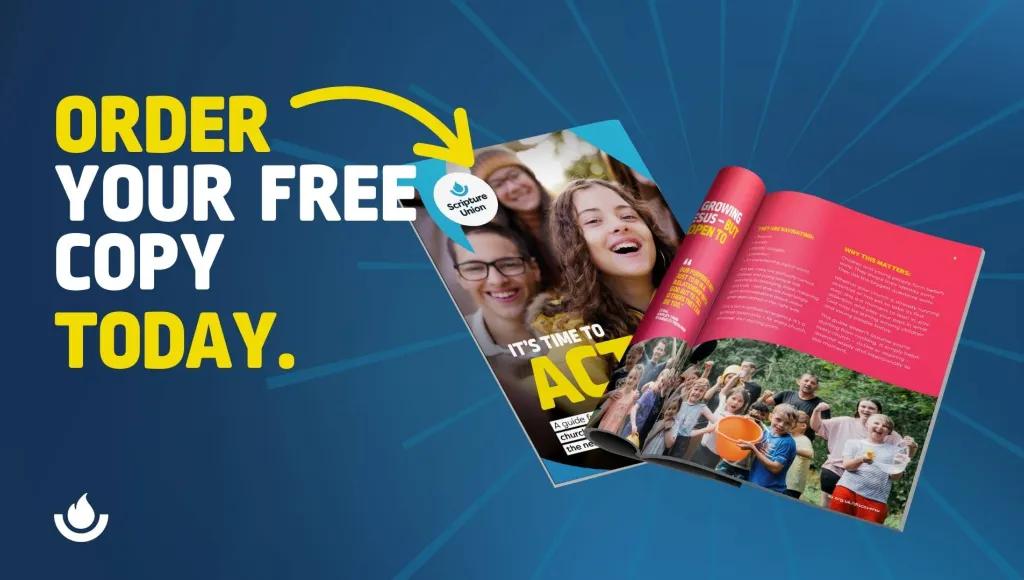
Equipping the church to reach the next generation
Across England and Wales, increasing numbers of children and young people are asking big questions about life, faith and meaning. Many are more open than we might assume – curious, thoughtful, and ready for conversations about Jesus, even when church isn’t part of their everyday world. For churches who have a heart for the next generation, this presents a real and hopeful opportunity.
Many leaders carry a deep desire to help the next generation encounter Jesus, but with full diaries and many responsibilities, knowing how to respond – or where to begin – can feel uncertain. That’s why we’ve created the It’s Time to Act guide.
It’s a simple, encouraging resource designed to help churches take thoughtful, realistic steps towards revealing Jesus to the next generation. Rather than offering big programmes or quick fixes, the guide focuses on what’s possible now – small, achievable actions that can grow over time. Inside, you’ll find practical ideas shaped by real church life that work alongside busy schedules and varied contexts. So, whether your church is just beginning to explore this opportunity, or already taking steps, the guide aims to meet you where you are and help you discern what comes next.
Our hope is that It’s Time to Act feels less like another initiative, and more like an invitation – to notice where God is already at work, and to take a next step, one step at a time.
If you’d like to explore the guide and see whether it could support your church, you can order a copy here.